
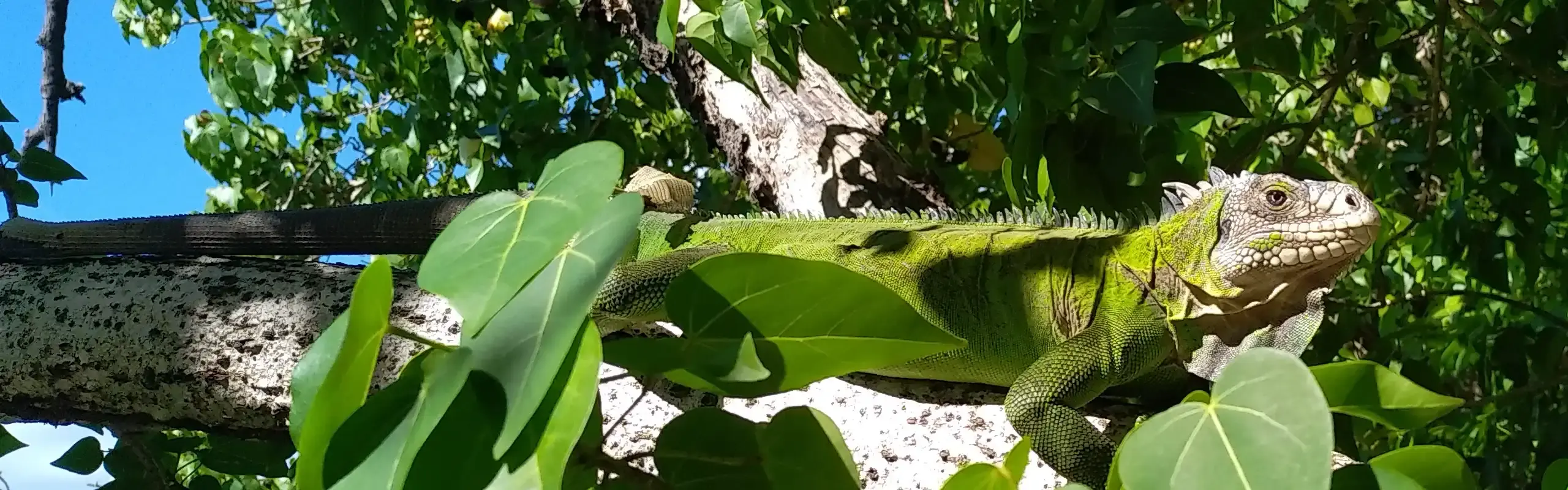
Îlet Chancel (Chancel islet): iguanas and white-sand shallows in the Baie du Robert
Martinique's largest islet is home to the best-monitored population of Lesser Antillean iguanas on the island, a few minutes from the Le Robert dock. A species found nowhere else but the Lesser Antilles, on an islet where you cannot simply come ashore.
The largest islet in Martinique
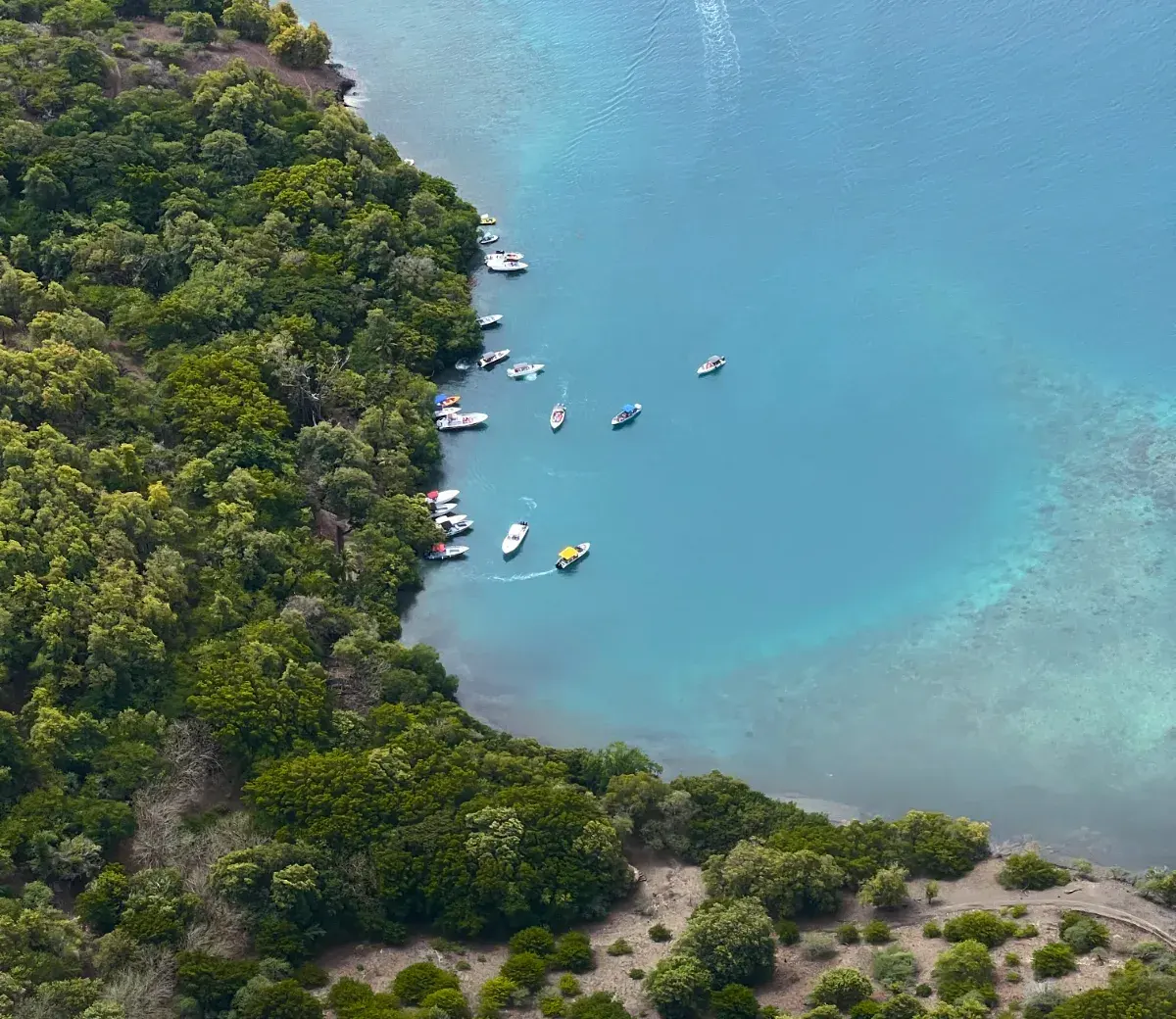
The Baie du Robert opens onto the Atlantic coast, closed off at sea by a coral barrier that breaks the swell and leaves calm water behind it, dotted with 10 islets. The largest of them is îlet Chancel (Chancel islet): 2,100 meters long and 900 meters at its widest. Its area varies across the documents of the DEAL (the French State's regional directorate for environment, planning and housing), from 70 hectares in the brochure for its protection order to nearly 80 in its naturalist inventory.
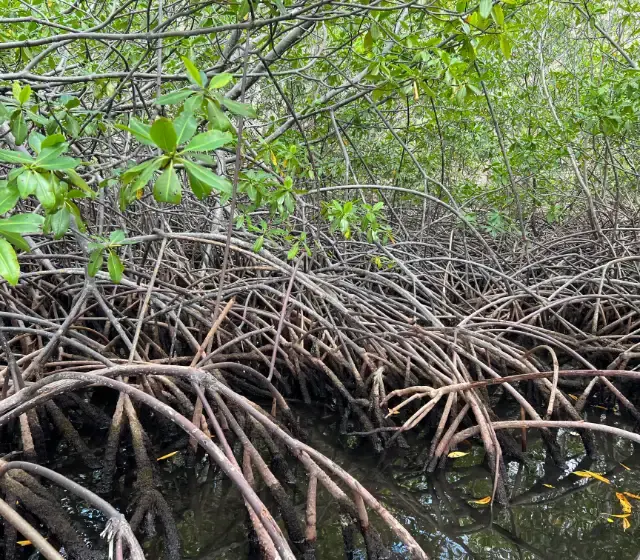
Its proximity to the coast of Le Robert makes it, according to the DEAL's inventory of natural areas, a refuge for bats and above all for the iguana. The terrain is low and dry, covered by a coastal forest dominated by the pink trumpet tree (Tabebuia heterophylla), the portia tree (catalpa) and the manchineel; a few cliffs make part of it completely inaccessible, even to the scientists who work there.
The Lesser Antillean iguana, critically endangered
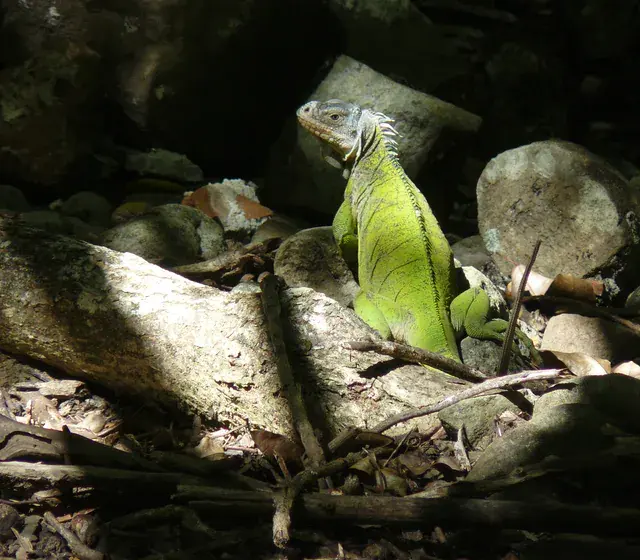
Îlet Chancel is known first of all for its iguanas, and not just any iguanas. Iguana delicatissima, the Lesser Antillean iguana, lives nowhere else in the world but in this archipelago, and the IUCN Red List has classed it as critically endangered since 2018. The islet shelters the best-known population in Martinique: studied since the 1990s, it has been monitored by capture-mark-recapture since 2012, with a break in 2022 and 2023.
The April 2025 survey, led by the Société herpétologique de France (French herpetological society), puts the population at 368 iguanas, within a range of 322 to 428, a figure close to 2024's. That is lower than the projections made over the previous years, and its authors consider the situation worrying for the survival of this population.
The species is essentially arboreal: during the 2017 mission, 76% of the iguanas were observed in trees. That does not mean they are easy to see. An adult spends most of the day motionless, its coloring blends in with the bark, and the Chancel population has resting habits that make it noticeably more discreet than elsewhere. It is spotted by a frozen silhouette, rarely by a movement, and an eye used to the site sees several where a fresh eye sees none.
Two iguanas that look alike
The main threat is not the visitor, it is a cousin: the common iguana (Iguana iguana), introduced to the Antilles, hybridizes with the endemic species and produces fertile offspring that dilute it until it disappears. In early 2017, common iguanas were spotted around other islets of the Baie du Robert, about two kilometers from Chancel; none was found on the islet itself. The black rat, for its part, preys on eggs: a rat-eradication operation was carried out in 2023, but the return of rats to the islet was confirmed in 2025, probably from the neighboring islets, including La Grotte, only 150 meters away.
The white-sand shallows (fonds blancs): standing in open water
A white-sand shallow is neither a beach nor a lagoon: it is a shoal of pale sand, made of coral debris and coarse sands, that rises almost to the surface, offshore. The depth does not exceed two meters. You cut the engine, step off the boat, and stand waist-deep in the middle of the sea.
These shoals are strung along the Atlantic coast, sheltered by the barrier reef. The best known is the Baignoire de Joséphine (Josephine's Bath), between îlets Oscar and Thierry (Oscar and Thierry islets), in Le François; others exist at Le Robert, toward Pointe la Rose. Seen from above, they form pale patches in the middle of the lagoon: our guide to flying in an ultralight (ULM) explains how the color of the water is read from an aircraft.
A white-sand shallow is not a snorkeling spot
Three centuries of history, three names
The islet was called îlet Monsieur (Monsieur islet) in the 17th century, then îlet Ramville (Ramville islet) when Dubuc de Ramville acquired it and set up a sugar mill and a pottery there, before taking, at the end of the 19th century, the name of the Lagrange-Chancel family, who bought it. Hurricanes got the better of the installations: remains survive in the vegetation, which you walk through on the way up to the plateau.
The islet is private property today. That status, as much as the biotope protection order, is why you cannot land there freely.
Approaching the iguanas without harming them
The Lesser Antillean iguana is a protected species: disturbing, capturing or transporting it is prohibited. The rules below are not precaution for its own sake: in a population of about 370 individuals, every breeding failure counts.
Do
- Stay on the trails and in the areas open to visitors.
- Observe from a distance and without sudden movements: an iguana that freezes or puffs out its dewlap is a disturbed iguana.
- Tell your guide about any iguana that looks different from the others: that is how common iguanas are spotted, and their presence on the islet would be an emergency.
- Take all of your trash with you, picnic leftovers included.
Never do
- Feed the iguanas, even a piece of fruit: it habituates them to humans and upsets their diet.
- Touch them, catch them or chase them for a photo.
- Take shelter under a manchineel tree or touch its fruit: its sap burns the skin, even when it runs down with the rain.
- Land alone from a kayak or a private boat: the islet is private property.
A trained guide, not an improvised one
When to go
The islet can be visited year-round. Like all reptiles, the iguana regulates its temperature in the sun: in clear weather it basks, and in overcast weather or after a shower it takes cover and becomes very hard to see. A clear day is worth more than any particular season.
Mating takes place around March: the window from March 15 to April 15 is the one scientists choose every year for their counts, so as to compare data taken at the same point of the cycle. From July to October, the rainy season (hivernage) brings more frequent showers, brief but enough to send the iguanas back under cover.
Sources
See the 8 sources for this guide
- Angin B., 2017. Étude de la population d'Iguana delicatissima de l'îlet Chancel, mission 2017 (in French) (Ardops Environnement / DEAL Martinique)
- Pauwels J., Duporge N., Trochet A., 2025. Suivi de la population d'Iguane des Petites Antilles par capture-marquage-recapture sur l'îlet Chancel (in French) (Société herpétologique de France / ONF)
- Brochure de l'arrêté de protection de biotope de l'îlet Chancel (in French) (DEAL Martinique)
- Inventaire ZNIEFF, zone 0025, l'îlet Chancel, version mise à jour en 2011 (in French) (DEAL Martinique)
- Inventaire du patrimoine géologique de la Martinique, fiche 29, 2012 (in French) (BRGM / DEAL Martinique)
- Iguanes : le dossier et le plan national d'actions (in French) (DEAL Martinique)
- Iguana delicatissima on the IUCN Red List of Threatened Species (IUCN)
- Dératisation de l'îlet Chancel en Martinique (in French) (Initiative espèces envahissantes outre-mer)
Photo credits
Photographs by AGEM Excursions, except those listed below:
How to get there
There is no bridge or shuttle. You reach Îlet Chancel by sea, from Le Robert, and landing requires the owners' agreement: approaching the islets by kayak is possible but regulated. In practice, the visit goes through an operator authorized to take its passengers there.
Our boat trips that land on the islet
Two options leaving from the Le Robert dock, both with a guided visit of the islet, a swim in a white-sand shallow and snorkeling near the reefs.