
Sea turtles in Martinique: where to see them, how to approach them
Five species visit Martinique's waters, three are actually encountered, and none may be approached freely: disturbing them is an offense, and the underwater meadows that feed them are under pressure. Where to look, when, and how far away to stop.
Five species, three possible encounters
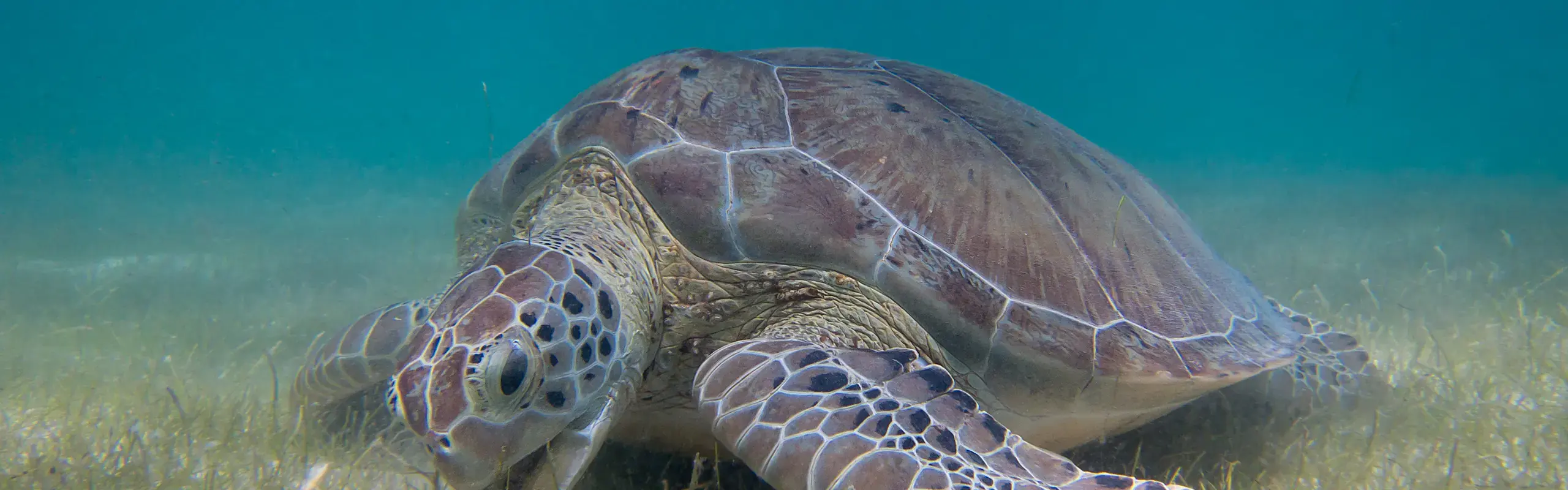
Five species of sea turtles visit the waters of the French Antilles: the green turtle (Chelonia mydas), the hawksbill (Eretmochelys imbricata), the leatherback (Dermochelys coriacea), the loggerhead (Caretta caretta) and the olive ridley (Lepidochelys olivacea). In Martinique, the last two remain rare exceptions: in practice, an encounter at sea will be a green or a hawksbill.
Telling them apart is simpler than it looks, and it comes down to each one's diet. The green turtle grazes on seagrass beds: rounded beak, small head, it settles on the bottom and comes up to breathe without hurrying. The hawksbill eats sponges: a pointed, bird-of-prey beak, shell scales that overlap like roof tiles, a saw-toothed rear edge, and it is more often seen probing the reef. The leatherback looks like no other: no scales at all, skin stretched like leather, and several hundred kilograms. You come across it at sea by chance, never on demand.
These rankings come from the Martinique Red List, which assesses the island's populations. They do not always match the world list: in October 2025, the IUCN removed the green turtle from the list of threatened species worldwide, while it remains critically endangered here.
These three rankings sum up why the rest of this guide is mostly about distances. A population ranked critically endangered does not recover from one season of disturbance: every female that gives up coming out of the water is a lost clutch, and the reproduction of these species is measured in decades, not years.
Where you see them, and where you don't
The images you have probably seen almost all come from the Caribbean coast, Anse Dufour and Anse Noire (Dufour Cove and Black Cove) first among them: enclosed bays, calm water, a seagrass bed 20 meters from the shore, so green turtles visible from the beach. That is where an encounter is most likely, and also where it is most closely supervised, because visitor numbers there are huge.
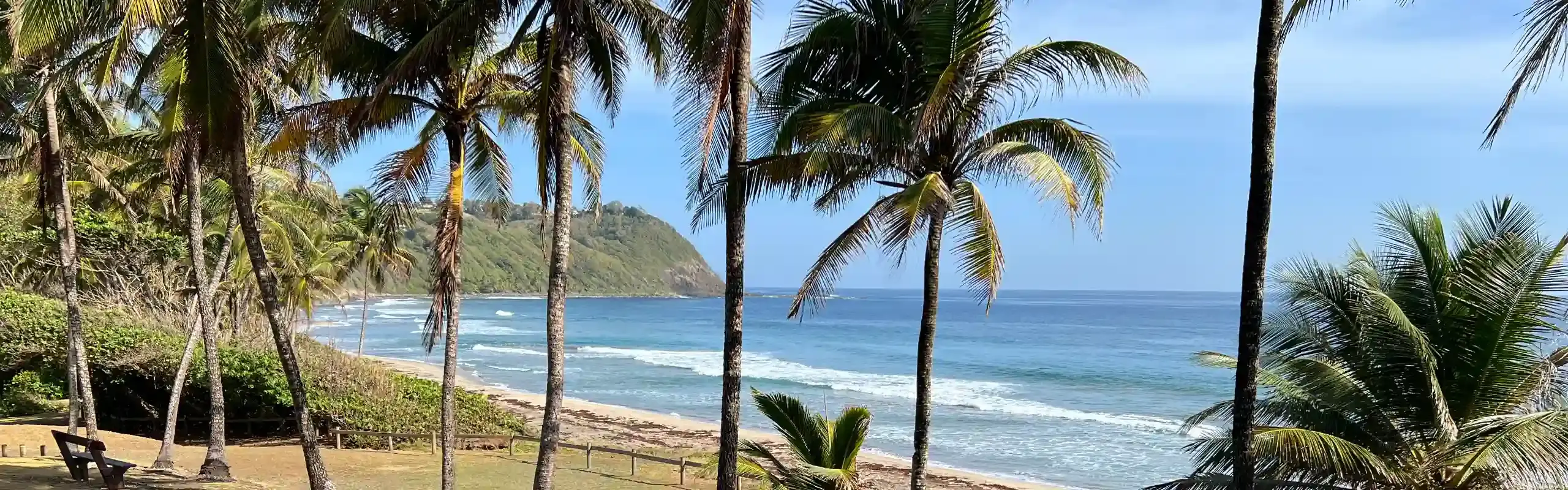
The Atlantic coast, the one of Le Robert and Le François, works differently. The swell rules out this kind of swimming from the shore, but behind the barrier reef, the sheltered bays hold vast seagrass beds where green turtles come to graze. You do not watch them from a beach: you come across them from a boat, between two islets, or by floating over a seagrass bed with a mask. It is more hit-or-miss and more peaceful.
Nobody can guarantee you a turtle
What they eat, and what threatens it
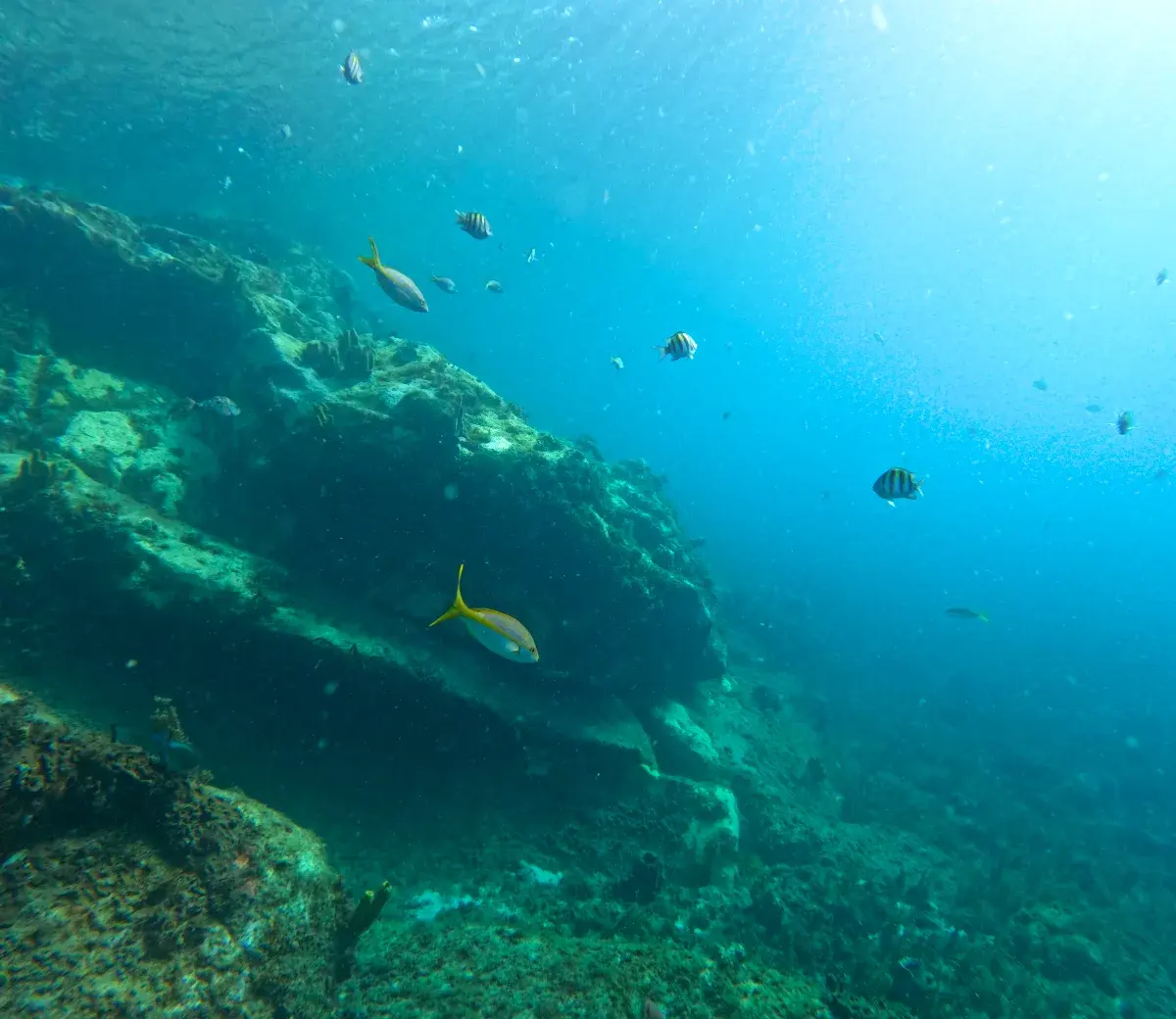
The green turtle is herbivorous as an adult, and its grass bears its name: Thalassia testudinum, turtle grass, one of the seven species of marine flowering plants in Martinique. These meadows are not scenery. They anchor the sand, oxygenate the water, serve as a nursery for juvenile fish before they move on to the reef, and feed the turtles.
The 2020 assessment notes deep changes in the composition and structure of the seagrass beds, and the spread of a plant from elsewhere, Halophila stipulacea, which is taking the place of the local species. The pressures identified are water pollution, the proliferation of microalgae, trampling, and the plowing by anchors and chains. Protecting a turtle without protecting its seagrass bed is like watching over an animal while tearing down its kitchen, which is why the two subjects are never treated separately. Our guide to the white-sand shallows comes back to what may be trampled and what must be stepped over.
Nesting, and the beaches that close
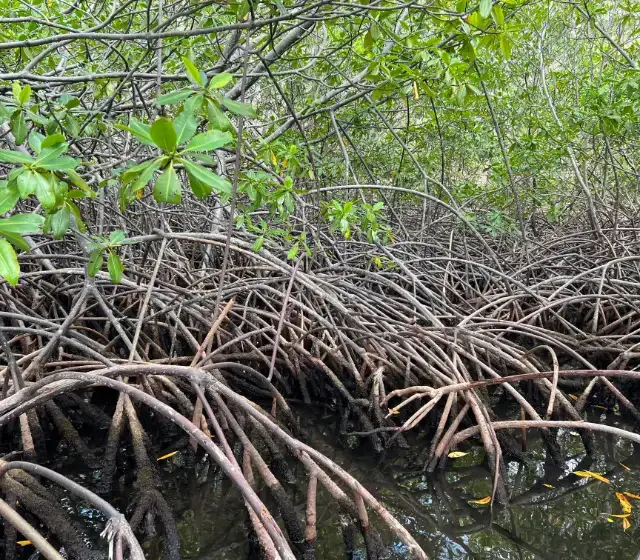
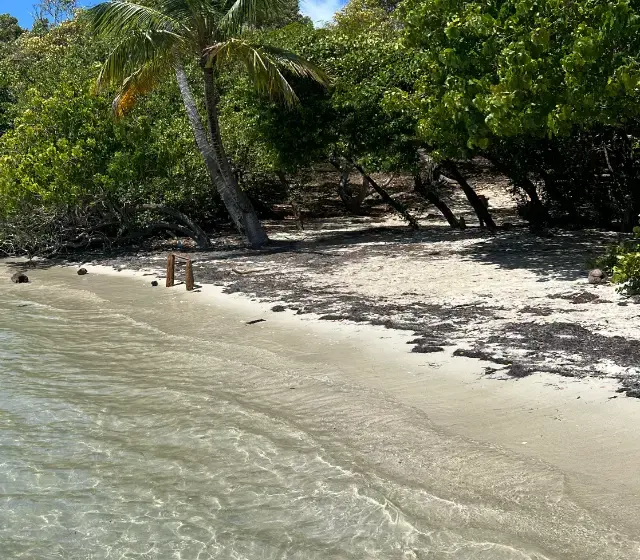
A female comes out of the water at night, climbs above the strandline, digs a nest and lays her eggs in it, then leaves. Incubation lasts about two months. Everything in this sequence depends on darkness and calm: a light, a silhouette in front of her, a dog, and the turtle turns back without laying. This turning back has a name in the monitoring programs, the false crawl, and it counts as a failure.
That is why some islets close. Several of them, on this coast, are covered by a biotope protection order: some prohibit landing during the breeding season only, others year-round, because they also host seabird colonies. These closures are not advisory: they apply to boats and kayaks alike.
The general framework is the national action plan for the sea turtles of the French Antilles, in force from 2020 to 2029, led by the DEAL (the French State's regional directorate for environment, planning and housing) and run by the Office national des forêts (French national forestry office), which brings together 36 actions across three territories. Part of this work relies on volunteers who record nesting tracks at first light, all around the island.
How far away, and why
Sea turtles are fully protected: destroying, handling or disturbing them are offenses, punishable by up to 150,000 euros in fines and three years in prison. The law punishes disturbance without putting a number of meters on it: the distances below are the ones the Antilles sea turtle networks publish to stay on the safe side of it, and they apply to everyone, crew included.
Do
- Stay at least 5 meters from the animal, and at the surface: do not free-dive down toward it.
- Swim slowly, without sudden movements, and let it choose whether to come closer or not.
- Watch a nesting female from 10 meters, behind her, leaving the front completely clear.
- Turn off all artificial light on a nesting beach, headlamps and phone screens included.
Never do
- Touch it, stroke it or try to ride it, even when it is still and even "just for a second."
- Chase it or cut across its path when it comes up to breathe: it needs the surface.
- Use a flash, by day or by night.
- Handle hatchlings to help them reach the sea: you clear the way, you do not carry them.
Disturbance shows before the offense
An injured, disoriented or stranded turtle
Handling a protected species is reserved for trained and authorized people. Faced with a dead turtle, an injured one, one caught in a net, or a hatchling that cannot reach the sea, the only right reaction is to call.
Stranding network: 0696 234 235
When to try your luck
There is no turtle season in the sense that there is a whale season. Green and hawksbill turtles live here year-round: what varies is your ability to see them. Flat water and clear light multiply the chances, a surface chopped up by wind reduces them to almost nothing, whatever the number of animals under the hull.
The morning remains the best window, for the same reason as elsewhere on this coast: the wind picks up during the day and the sky clouds over on the high ground. And since an encounter cannot be ordered up, the right instinct is to go for the trip itself, the islets, the mangrove and the white-sand shallows, treating the turtle for what it is, a pleasant surprise.
Our boat trips
Our boat trips take place in the Baie du Robert (Robert Bay), over the seagrass beds and along the reefs, with a snorkeling stop on every option. The program stays the same whether or not you come across a turtle: it is not on the program, it comes on top. Îlet Chancel (Chancel islet) and its iguanas, on the other hand, is on the program.
Two options leaving from the Le Robert dock
Snorkeling near the reefs, a stop at a white-sand shallow and a guided visit to îlet Chancel in both cases, with the full day adding the Creole lunch on îlet Madame (Madame islet).
Sources
See the 10 sources for this guide
- Les bons gestes : observation en mer, à la ponte et à l'éclosion (in French) (Réseaux Tortues marines des Antilles)
- Le plan national d'actions tortues marines des Antilles françaises 2020-2029 (in French) (DEAL / Office national des forêts)
- Les espèces de tortues marines de la Martinique (in French) (Réseau Tortues marines Martinique)
- La Liste rouge des espèces menacées en France, faune de Martinique, 2020 (in French) (UICN France / MNHN)
- La tortue verte n'est plus considérée comme une espèce menacée, octobre 2025 (in French) (Nausicaá)
- En cas de rencontre : tortue blessée, morte ou émergence (in French) (Réseau Tortues marines Martinique)
- Le réseau échouage RETOM : quand et comment appeler (in French) (Réseau Tortues marines Martinique)
- Les herbiers, herbes ou algues ? (in French) (Parc naturel marin de Martinique)
- État de santé des récifs coralliens, herbiers marins et mangroves de Martinique, bilan 2020 (in French) (Ifrecor)
- Les îlets du Robert : îlets protégés, ponte et régimes d'accès (in French) (Conservatoire du littoral)
Photo credits
Photographs by AGEM Excursions, except those listed below:
Ready for an adventure?
A boat trip or an airborne thrill: book now and enjoy an unforgettable experience in Martinique. Limited availability!