
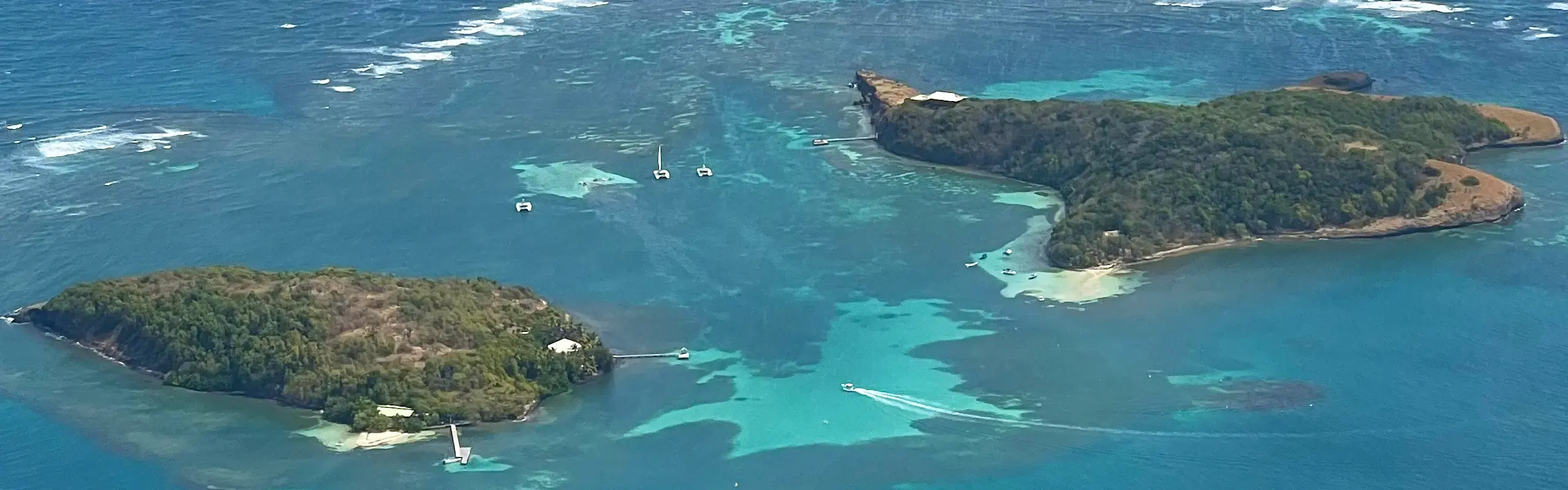
The Baignoire de Joséphine (Josephine's Bath) and the white-sand shallows: standing in open water
A bar of pale sand off Le François, less than two meters of water, and an imperial legend that does not survive a glance at the dates. What the white-sand shallows of the Atlantic coast really are, why they are found on this coast, and what lives under your feet while you soak there.
A white-sand shallow is neither a beach nor a lagoon
The confusion never goes away, and it comes from the photographs: you see clear water and pale sand, so you imagine a beach. There isn't one. A white-sand shallow is a shoal, a mound of sand set offshore, far from the coast. The boat cuts its engine, you climb down the ladder, and you find yourself standing in the sea, waist-deep.
That feeling, and nothing else, is what gives the place its reputation. Nobody goes to the white-sand shallows for the wildlife: the sand is a biological desert compared with the neighboring mangrove roots or coral heads. You go for a rare sensation: being able to stand in the open sea.
Why they are found on the windward coast
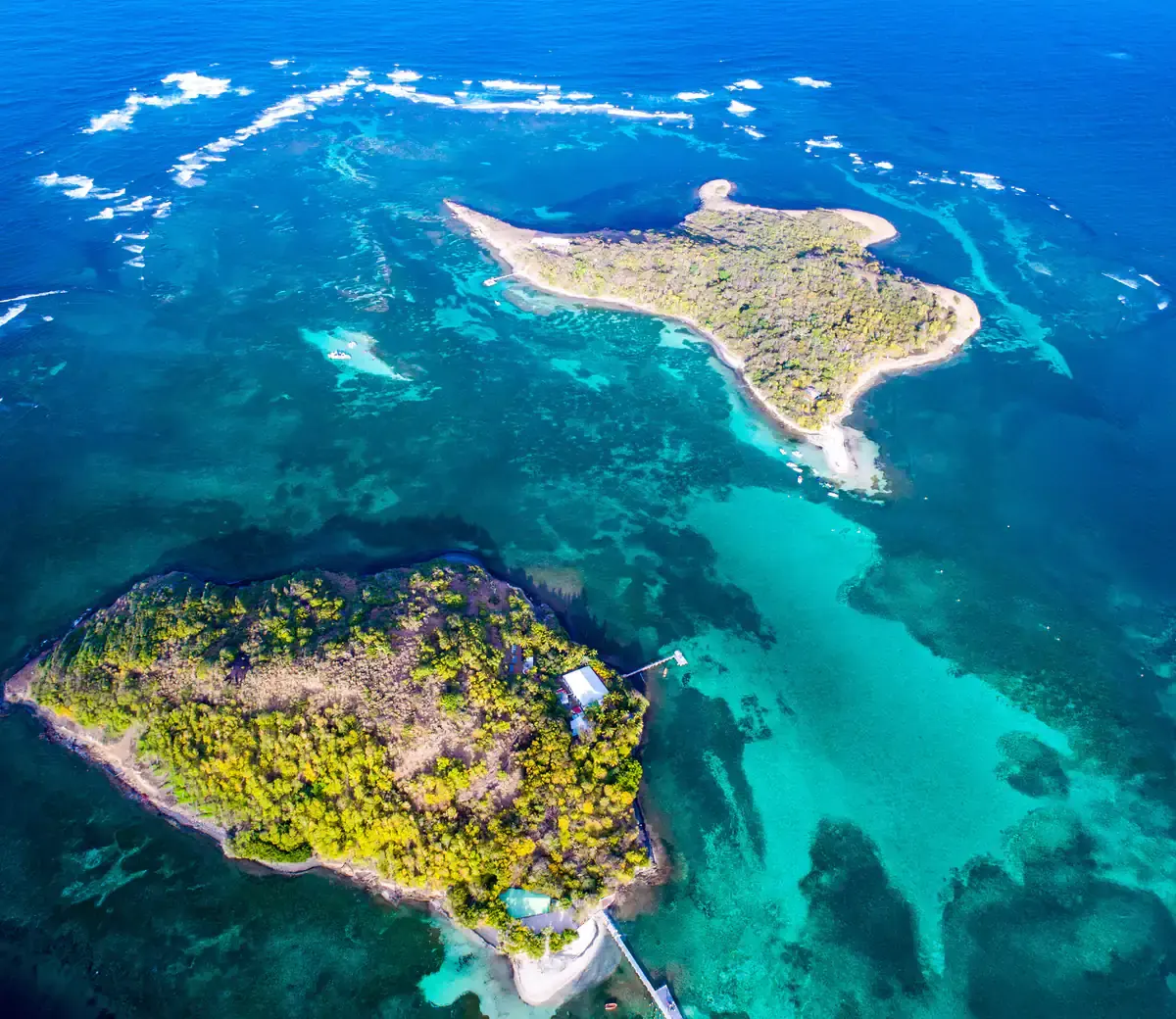
Three conditions have to come together, and in Martinique it is on the Atlantic coast that they do. First, you need a barrier reef offshore, which breaks the Atlantic swell and turns the sea into a calm stretch of water. Next, you need a sand factory: the reef, slowly breaking down, constantly produces debris of coral, shells and calcareous algae. Finally, you need currents weak enough for this debris to settle rather than be carried out to sea.
The result has a name in geology: a bioclastic sediment, meaning a sand made exclusively of the remains of living things. Its whiteness has nothing mineral about it, it comes from the limestone in the skeletons. That is also what explains the color of the water: a very pale bottom sends light back toward the surface instead of absorbing it, and the turquoise people photograph is just sunlight that has made the round trip.
These figures come from the geological heritage inventory of Martinique, which lists the white-sand shallows of Le François among the island's remarkable sites. They extend between îlets Thierry, Oscar, Métrente and Long. The same inventory points to other sandy shoals farther north, at Le Robert toward Pointe la Rose, and farther south, off Baie Sans-Souci (Sans-Souci Bay) at Le Vauclin.
Seen from an ultralight (ULM), the whole picture reads at a glance: the white-sand shallows appear as pale patches in the middle of the lagoon, and you finally understand how they connect to the reef. Our overflight guide goes into this reading of the color of the water.
Where Josephine's name comes from
The version you will hear on almost every boat fits in one sentence: the future Empress Josephine, born in Martinique, used to come and bathe here. It is a lovely story, and quite probably just that, a story. Marie-Josèphe-Rose Tascher de la Pagerie was born in Les Trois-Îlets in 1763, on the other side of the island, and left Martinique as a teenager, in 1779, to marry Alexandre de Beauharnais. She would return from 1788 to 1790. Her biography never places her at Le François, and the geological inventory itself keeps its distance: it reads "history says."
Two other, more prosaic leads
Where people actually swim
The Baignoire de Joséphine itself lies off Le François, between îlet Oscar and îlet Thierry, on a bank where the depth does not exceed two meters. It is the best known of the white-sand shallows, a tourist hotspot of the island, and it gets crowded. Its coordinates are 14° 37′ 42″ north and 60° 50′ 56″ west: see the location on the map.
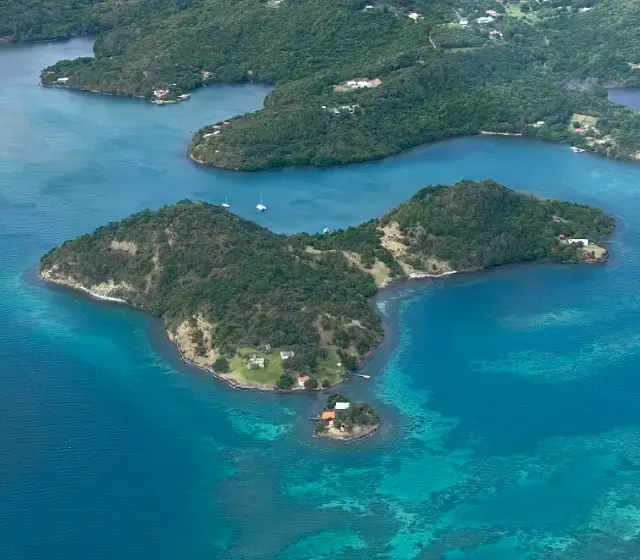
Farther north, the Baie du Robert (Robert Bay) and its 10 islets shelter behind the same reef, with sandy shoals of their own. That is where our boat trips leave from, and it is also where îlet Chancel (Chancel islet) and its iguanas are found, which we combine in the same half day.
Being able to stand is no substitute for knowing how to swim
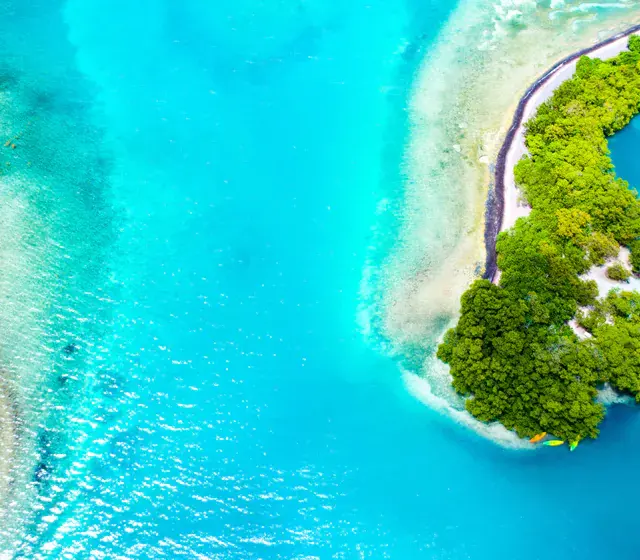
On the bank itself, the water rarely rises above an adult's waist, which is what makes the Baignoire a popular outing with families. But a shoal is not a swimming pool: you get down to it by a boat's ladder, its edges drop away to deeper water, and a child cannot touch bottom where an adult still can.
The rule on our boat trips
What is under your feet, and three meters away
The shoal itself is bare sand, and it takes being walked on very well. What borders it, on the other hand, does not take it at all. Around every white-sand shallow the seagrass beds begin, those underwater meadows of flowering plants that people mistake for algae. Martinique has seven species, two of which dominate: Thalassia testudinum, aptly called turtle grass, and Syringodium filiforme, manatee grass.
This plant from elsewhere is gaining ground on the local species, and that is one more reason to spare those that remain. A seagrass bed holds the sand in place, oxygenates the water, serves as a nursery for juvenile fish and feeds green turtles; it takes years to recover once an anchor has plowed a furrow through it, and it dies under repeated footsteps. The threats on record are water pollution, the proliferation of microalgae, anchors and chains, and trampling. The last two are the only ones a visitor has any hold on.
The practical rule is simple: pale sand is for walking on, the green carpet is for swimming over. If you want to see what lives in a seagrass bed, put on a mask and float above it, because that is where turtles pass, and our dedicated guide details the rules for approaching them.
Swimming there without damaging it
A white-sand shallow has neither a warden nor a sign. What protects it depends entirely on how boats stop there and how people behave on it, which makes the list below more useful than a regulation.
Do
- Stay on the pale sand and swim over the green areas rather than walking on them.
- Bring back on board everything that came down with you, cups and bottles included.
- Apply sunscreen on land, at least 20 minutes before swimming, or wear a T-shirt instead.
- Tell your captain about any turtle or ray you spot, so the group keeps its distance.
Avoid
- Drop anchor by guesswork: on a seagrass bed, an anchor leaves a furrow that takes years to close.
- Take sand, a shell or a piece of coral, even dead: it is part of the stock that feeds the shoal.
- Feed the fish or rays that come up to the boats.
- Walk on the dark areas of the bottom thinking it is mud: it is alive.
Pale sand doubles the sun
When to go
The white-sand shallows can be enjoyed year-round: the reef shelters them from the open sea, so they are little affected by the swell that makes the Atlantic coast impressive from the shore. What really changes from one day to the next is the light. It takes sun for the bottom to send back the turquoise; under an overcast sky, the same water looks gray and you wonder what you came to see.
What to bring
Sargassum, the wild card of the Atlantic coast
Since 2011, Martinique has suffered massive, repeated strandings of sargassum, brown algae that drift in mats from the open Atlantic. The windward coast is on the front line. The DEAL of Martinique (the French State's regional directorate for environment, planning and housing) identifies three major episodes, in 2011, in 2014-2015 and in 2018-2019, and now considers the phenomenon lasting: 41,000 metric tons were collected in 2018, 15,000 in 2019.
The health problem comes from the stranded algae: as they decompose on the shore, they release hydrogen sulfide and ammonia, which 15 measuring stations were tracking in 2020. Offshore, on a shoal, you are more likely to meet floating mats, which turn the water brown and spoil the swim.
What nobody can promise
Sources
See the 8 sources for this guide
- Inventaire du patrimoine géologique de la Martinique, BRGM/RP-61443-FR, 2012, fiche 29, Les Fonds Blancs du François (in French) (BRGM / DEAL Martinique)
- Gestion des échouages de sargasses en Martinique, avancées et perspectives, 18 juin 2020 (in French) (DEAL Martinique)
- Les herbiers, herbes ou algues ? (in French) (Parc naturel marin de Martinique)
- État de santé des récifs coralliens, herbiers marins et mangroves de Martinique, bilan 2020 (in French) (Ifrecor)
- Baignoire de Joséphine : coordonnées et trois hypothèses sur le nom (in French) (Wikipédia)
- Les îlets du Robert : îlets protégés et régimes d'accès (in French) (Conservatoire du littoral)
- Joséphine de Beauharnais (1763-1814), biographie et chronologie (in French) (Fondation Napoléon)
- Statue de Joséphine de Beauharnais (détruite), Fort-de-France (in French) (Fondation pour la mémoire de l'esclavage)
Photo credits
Photographs by AGEM Excursions, except those listed below:
- Trou cochon, Mickaël BRUNO, CC BY-SA 4.0
How to get there
No white-sand shallow can be reached from the coast: you get there by boat, and that is all. The Baignoire is off Le François, the nearest town, and within sailing range of Le Robert, farther north, where our boat trips leave from: half a day is enough to stop there.
Our boat trips that stop at a white-sand shallow
Both options stop on a shoal in the Baie du Robert and at the Baignoire de Joséphine, with the aperitif served feet in the water and a visit to the iguanas of îlet Chancel.